US Startup's AI Avatar Passes for Human in Job Interviews, 48% Fooled
A US-based startup, Tavus, claims its latest AI avatar, Griffin, can convincingly imitate a human interviewer, blurring the line between human and machine. In a simulated job interview involving 54 participants, 48 per cent believed they were interacting with a real person, according to reports by the New York Post. This suggests the technology closely replicates aspects of face-to-face communication.
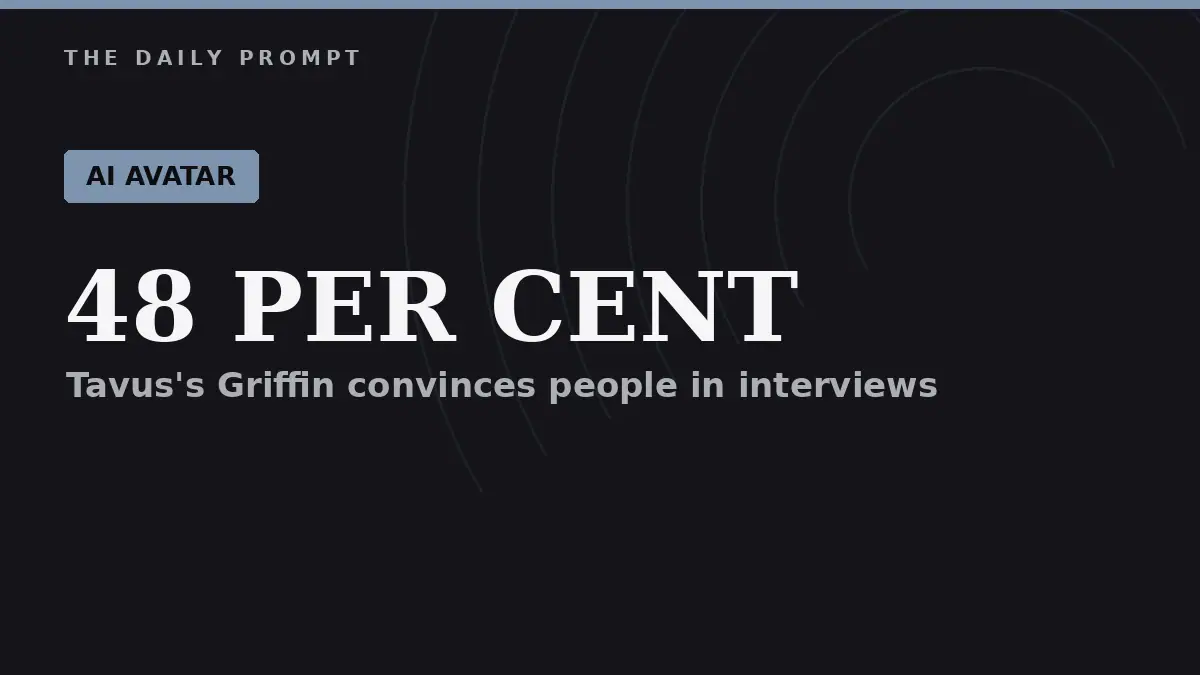
Tavus stated that these results indicate Griffin could potentially pass the Turing Test, a benchmark used to determine if a machine's behavior is indistinguishable from a human's during interaction. Participants who mistook the AI avatar for a human were, on average, 79% confident in their judgment. Conversely, those who correctly identified it as an AI system were, on average, 81% confident in their assessment.
Griffin generates every pixel of each video frame in real time using a single reference image, recreating visual elements such as arms, fingers, chairs, shadows, and backgrounds, alongside facial features and movements. The avatars are available in both male and female appearances and are designed to replicate natural human behaviors like blinking and breathing, aiming for more authentic interactions.
Hassaan Raza, CEO and co-founder of Tavus, emphasized that human communication extends beyond spoken language, encompassing facial expressions, gestures, vocal tone, and timing. He noted that "Humans are evolutionarily designed to communicate face to face," and "So much of human communication is non-verbal." Raza highlighted Griffin's aim to overcome shortcomings of earlier AI avatars, which often exhibited unnatural reactions such as smiling at bad news.
Griffin has demonstrated its ability to respond to changing conversations, interrupt appropriately, and handle interruptions without losing track of the discussion, adapting to new topics as interactions unfold. In one instance, the avatar guided a participant through solving a Rubik’s Cube, showcasing its capacity to respond to visual information. Another demonstration involved the AI model successfully participating in a game of Simon Says. The company believes this technology could find applications in education, including AI-powered tutoring and interactive learning experiences.
What to watch: Further advancements in AI avatars and their integration into various sectors like education.
Editor's note: The draft accurately reflects the source content, including the specific statistics regarding participant confidence levels and the technical capabilities of the AI avatar.
AI-generated and fact-checked against the original report; claims the gate cannot verify are held back.