UN Warns World Must Cut Emissions by 18% in Four Years to Avoid Disastrous Climate Overshoot
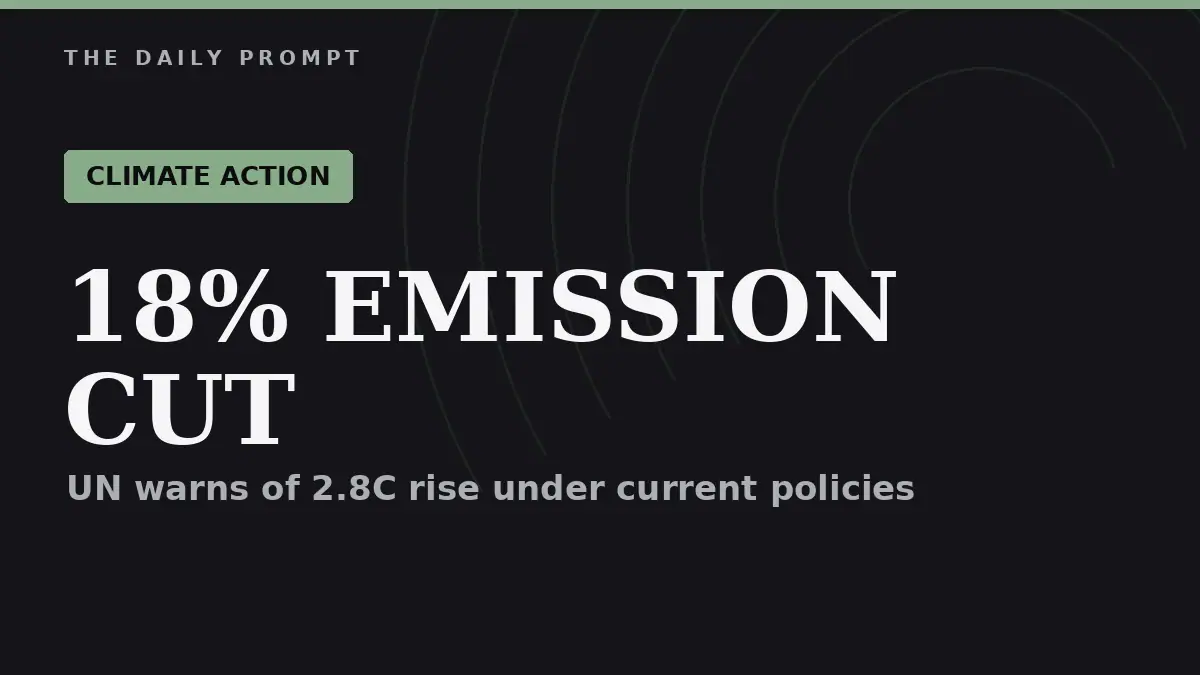
The world needs to cut carbon emissions by nearly a fifth in the next four years, and by close to half within a decade, to avoid overshooting climate targets by a disastrous margin, according to the UN Environment Programme (Unep). If current government policies remain unchanged, global temperatures are forecast to rise to 2.8C above preindustrial levels.
While the “window has closed” on holding temperature rises to 1.5C in line with scientific advice, limiting the “overshoot” of that target is still possible, Unep states. However, a report on the “emissions gap” between climate goals and policies found that countries are failing to translate their long-term emissions reduction targets into short-term actions. Global carbon output appeared to stall in 2025, with levels similar to the previous year, though Unep analysts are wary of calling this a peak due to geopolitical uncertainties and increased reliance on fossil fuels, despite strong growth in renewable energy.
Cutting greenhouse gases by 18% by 2030, and by 45% by 2045, would offer a good chance of limiting temperature rises to 1.7C above preindustrial levels. This would still allow events like recent record heatwaves to become frequent, but could help prevent them from worsening drastically. Inger Andersen, Unep’s executive director, stated, “It’s now clear the herculean effort was not made. We procrastinated, and now we are saying this window has closed.” She urged countries to maintain the 1.5C goal, aiming to “make the overshoot as brief and as short as possible.”
International political actions have drawn scrutiny. Under Donald Trump, the US, the world’s second-biggest emitter after China, withdrew from the Paris climate agreement and is threatening to reverse its trend of falling greenhouse gas emissions. Bill Hare, chief executive of the Climate Analytics thinktank, called on major fossil fuel producers like the US and Saudi Arabia, which produce 20-25% of global fossil fuels, to “stop playing politics and face the scientific reality.” Unep analysis indicated that pledges on greenhouse gases made last year were noticeably weak, with commitments at the Cop30 climate summit in Brazil last November falling short of what was needed.
Even if all updated pledges were fulfilled, Unep projects temperatures would still rise to 2.6C above preindustrial levels. Current policies, however, point to a 2.8C rise. Scientists fear that every five years of greenhouse gas emissions at current levels pushes up global heating forecasts by 0.1C, increasing the likelihood of triggering climate system tipping points. Mohamed Adow, director of Power Shift Africa, highlighted that while solutions like solar and wind power are growing faster than expected, governments are not moving away from fossil fuels quickly enough.
The Paris agreement’s “global stocktake,” an assessment of emissions targets, is scheduled for 2028. However, its effectiveness has been questioned after the UN’s Intergovernmental Panel on Climate Change (IPCC) failed to set a timetable to publish its latest report before this stocktake, potentially hindering governments from assessing progress against the latest science. Johan Rockström, director of the Potsdam Institute for Climate Impact Research, noted that if all current national commitments are implemented, global emissions are projected to reach approximately 50 gigatonnes of carbon dioxide equivalent annually by 2035, significantly higher than the target of below 35 gigatonnes.
One method identified by Unep to limit warming quickly involves cutting methane, a greenhouse gas 80 times more powerful than carbon dioxide.
What to watch: The next global stocktake in 2028 and the IPCC's report timeline.
Editor's note: The report effectively synthesizes the source material, capturing the core data and context without unnecessary filler.
AI-generated and fact-checked against the original report; claims the gate cannot verify are held back.