India's Emissions Growth Slows in 2025, UNEP Report Notes
India's upward trend of greenhouse gas emissions showed a significant change in 2025, pivoting from a path indicating rapid growth to a slight decline. This finding is reported in the United Nations Environment Programme's (UNEP) new "Emissions Gap Report 2026: The Point of Return," released on October 21. The report draws on data from multiple sources, with the Emissions Database for Global Atmospheric Research (EDGAR) and the International Energy Agency (IEA) both indicating a slight decline in India's emissions, while the Energy Institute estimates a marginal increase. Crucially, all three sources point to a departure from the country's previous pattern of swift emissions expansion.
The report attributes this shift partly to weather effects and structural changes within India's energy landscape, specifically towards renewable energy. Minal Pathak, a researcher at Ahmedabad University and a lead author of the UNEP report’s chapter on global emissions trends, commented in a written response to Mongabay-India that "The data this year is very encouraging." She further clarified that these changes are partly due to weather effects and structural shifts towards renewable energy, as highlighted in Chapter 2 of the report.
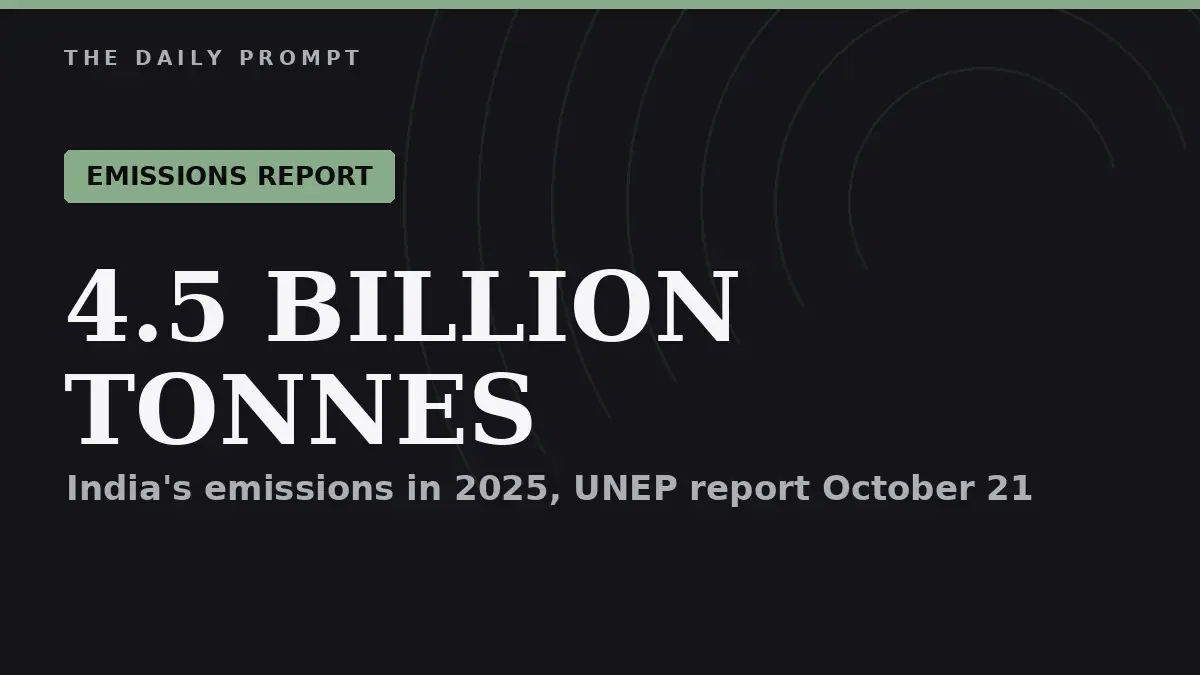
Despite this positive development, India remains the world’s third-largest greenhouse gas emitter, following China and the United States. The country's emissions reached approximately 4.5 billion tonnes of carbon dioxide equivalent (CO₂e) in 2025, a figure that excludes land use and forestry. However, India's per capita emissions stood at 3.1 tonnes, which is less than half the global average of 6.4 tonnes, providing a comparative perspective on its environmental impact.
What to watch: Continued monitoring of renewable energy's impact on India's emissions trajectory.
Editor's note: The article is comprehensive, though it leaves out the specific mention of the CREA analysis mentioned at the very end of the source text.
AI-generated and fact-checked against the original report; claims the gate cannot verify are held back.