Supreme Court Strikes Down UP's 2021, 2025 Pension Laws for Employees
The Supreme Court has invalidated the Uttar Pradesh Qualifying Service for Pension and Validation Act, 2021, and the Uttar Pradesh Entitlement to Pension and Validation Act, 2025, declaring them unconstitutional. This judgment, issued on November 18 in Uttar Pradesh Ground Water Department Non-Gazetted Employee Association (Regd.) & Anr. v. The Chief Secretary & Ors., provides significant relief to regularised Uttar Pradesh government employees and retirees. It specifically restores the right of eligible employees, regularised under a duly formulated scheme, to have their prior work-charged, temporary, daily-wage, or muster-roll service counted towards their qualifying service for pension, according to a Bar and Bench report.
For retired employees whose pre-regularisation service was previously excluded under these now-invalidated laws, the Supreme Court has outlined a clear process. Affected individuals may approach the competent authority with their claims for pension and other retirement benefits, providing full service particulars. These claims must be evaluated in line with the Supreme Court’s 2019 decision in Prem Singh v. State of Uttar Pradesh and other applicable laws. Authorities are mandated to decide on claims within six months of receipt and must extend benefits where due. Importantly, claims cannot be summarily rejected; authorities must provide a hearing before rejection and issue a reasoned order. Successful claimants will receive a detailed chart of payments under each head.
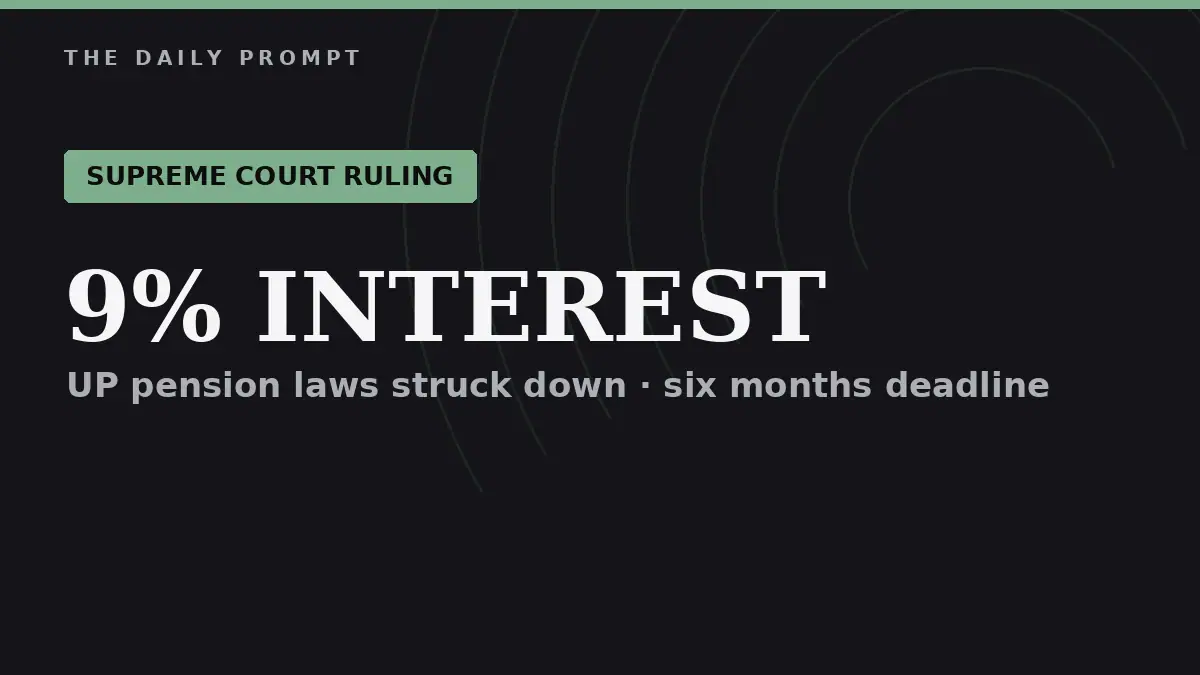
The Bench further clarified the calculation of monetary benefits. Pension benefits are to be computed “bearing in mind the restriction of monetary benefits to a period of three years preceding institution of the writ petition by Prem Singh.” This three-year restriction also applies to covered employees who died after the Prem Singh judgment. However, claims filed by heirs or legal representatives of employees who retired and died prior to the Prem Singh judgment are exempt from this restriction, provided they furnish unimpeachable proof of their status. While no interest was imposed on amounts already due, any payments delayed beyond the prescribed deadlines will attract 9% annual simple interest until release.
The court's decision stems from the Uttar Pradesh government's attempt to circumvent the 2019 Prem Singh ruling, which had established that work-charged service must count towards qualifying service for pension. Following this verdict, Uttar Pradesh enacted the 2021 and 2025 laws, both operating retrospectively from April 1, 1961. The 2021 Act linked qualifying service to appointments against temporary or permanent posts under stipulated service rules, while the 2025 Act introduced the category of “substantive appointee” to determine entitlement. The Bench struck down both statutes, explaining that regularisation erases the “birthmark” of an employee’s initial non-regular appointment, bringing them into the regular establishment. The Court held that denying retiral benefits by resurrecting this “obliterated birthmark” through retrospective legislation is unconstitutional, violating Articles 14, 16, and 21 of the Constitution, as it creates a class within a class and deprives a regular employee of a vested right. The Court also noted that the new definitions merely brought back the same exclusion struck down in Prem Singh, emphasizing that a legislature can only validate past actions by removing the legal defect, not by changing statutory labels. The Supreme Court also issued a final warning to the State of Uttar Pradesh, giving it six months to disburse required payments from the Prem Singh judgment, noting that further non-compliance could constitute aggravated contempt.
What to watch: The Uttar Pradesh government's compliance with the six-month deadline for disbursing payments.
Editor's note: The draft provides a comprehensive summary of the Supreme Court ruling, including the legal context, the specific laws invalidated, and the procedural requirements for claimants.
AI-generated and fact-checked against the original report; claims the gate cannot verify are held back.