US Threatens Tariffs on India Over Manufacturing Policies
The United States has threatened tariffs on Indian goods, arguing that India's manufacturing policies, including Make in India, Atmanirbhar Bharat, and Production Linked Incentive (PLI) schemes, risk creating "structural excess capacity and production" that burdens US commerce. The Trump administration's concern centers on India's drive to expand factories and strengthen supply chains to become a global manufacturing hub, viewing these efforts as potentially leading to overproduction.
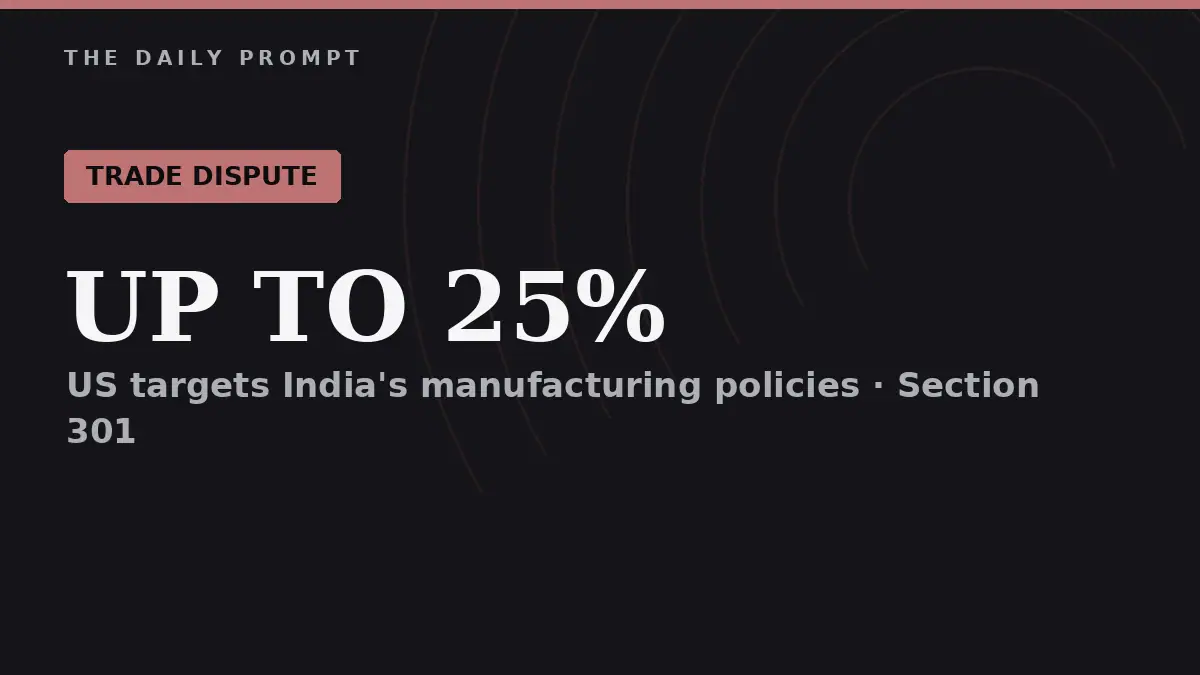
The US Trade Representative (USTR) determined that India's policies are "unreasonable" and restrict US commerce under Section 301 of the Trade Act of 1974. Following a 126-page report titled 'Report on India's Acts, Policies, and Practices Relating to Structural Excess Capacity and Production in Manufacturing Sectors', the USTR proposed tariffs of up to 25 per cent on Indian goods. This rate could be reduced to 17 per cent if a qualifying trade agreement is reached between the two nations.
Washington defines structural excess capacity as production persistently above what would exist under market-oriented conditions, often created or sustained by government policies and interventions. US officials contend that if domestic demand does not keep pace with factory expansion, Indian companies may be pushed towards export markets, directly competing with American manufacturers. This, the USTR states, could reduce commercial opportunities for US companies, contribute to lost production, exports, jobs, and investment in the US, and create economic-security risks.
The Make in India initiative, aimed at increasing manufacturing capacity and attracting investment, is explicitly named in the USTR report. Washington views India's top-down industrial efforts, manufacturing and export targets, and directed resources as problematic if growth is primarily government-fueled rather than market-driven. India's plan to raise manufacturing's share to 25 per cent of GDP, which would require roughly doubling current capacity, is seen by the USTR as being pursued through incentive schemes designed to encourage domestic production, import substitution, and exports.
The Production Linked Incentive (PLI) scheme is identified as an even more direct target. This scheme provides financial incentives to eligible companies based on incremental sales or production. The USTR argues that while not explicitly designed for excess capacity, the way such incentives operate can contribute to it when production expands without a corresponding increase in domestic demand. Similarly, Atmanirbhar Bharat, or Self-Reliant India, is scrutinized. While intended to strengthen domestic manufacturing and reduce import dependence, Washington's perspective is that these policies could promote domestic production beyond local demand, potentially distorting global trade.
Editor's note: Thorough and accurate report that captures nearly all key details from the comprehensive source text.
AI-generated and fact-checked against the original report; claims the gate cannot verify are held back.