Global Water Levels Plunge in Hottest Years on Record, Study Finds
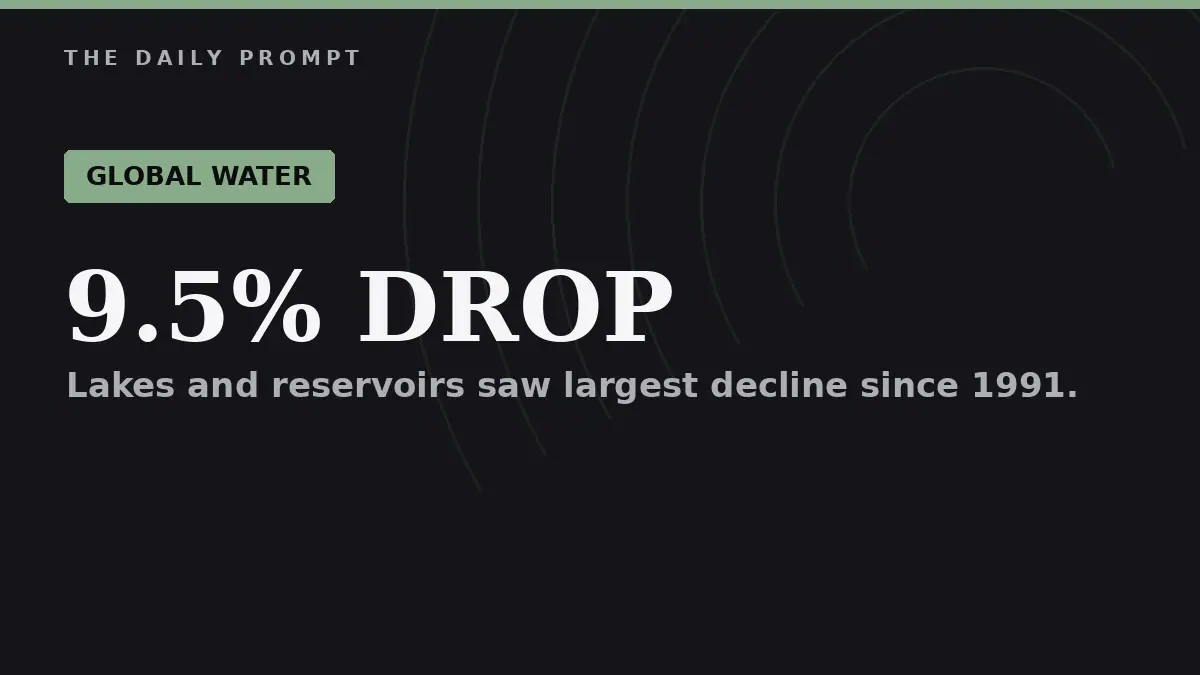
An international study has revealed an unprecedented decline in water levels across the world's lakes, rivers, and reservoirs during 2023 and 2024, the two hottest years on record. This analysis of global water systems, spearheaded by the Chinese Academy of Sciences, found that the planet’s surface freshwater experienced a sharp reduction. Global river flows dropped to approximately 5.7% below normal, while the water stored in lakes and reservoirs decreased by 9.5%. Collectively, this represents the largest synchronized decline in surface water observed since at least 1991.
Researchers attribute this phenomenon to a warming planet, where a hotter atmosphere extracts more moisture from soils, rivers, and lakes, with increased land temperatures accelerating evaporation. This moisture then often precipitates as heavy rainfall elsewhere, frequently over oceans, leading to more pronounced swings between periods of drought and flood. Consequently, during 2023-24, many rivers ran low even in regions that simultaneously experienced severe flooding, highlighting a complex and challenging hydrological pattern. The study's methodology involved combining river flow measurements from 150 of the world’s major river basins with satellite data that tracked over 1.2 million lakes and reservoirs between 1991 and 2025.
Dr. Sulagna Mishra, one of the study’s authors, underscored a "paradox of climate change," explaining that a warmer atmosphere does not automatically ensure greater water availability on land. Despite an increase in global precipitation during this period, a significant portion of the additional rainfall occurred over oceans, leaving many land regions grappling with substantial deficits. The effects of this decline were particularly acute in South America, where river flows plummeted by 17.8% and water in lakes and reservoirs fell by 16.5%. This dramatic reduction occurred even as some areas within the continent were simultaneously experiencing extreme rainfall and flooding, a point elaborated by Dr. Yi He, an associate professor in hydrology at the University of East Anglia, who noted that "A river can flood during a downpour and still run low for much of the year."
The findings highlight the significant exposure of the world's water supplies to multiple threats, including the super El Niño, climate crisis-driven droughts, pollution, and overexploitation. The authors of the study emphasized that changes to freshwater resources are among the primary ways the climate crisis impacts both people and nature, and predicting water availability is becoming increasingly difficult as global temperatures continue to rise. Professor Christian Dunn, chair of the British Ecological Society’s policy committee, expressed concern over "how quickly our freshwater resources can decline, even in parts of the world we traditionally think of as being wet," adding that experiencing floods does not equate to water security. Professor Richard Allan, a climate scientist at the University of Reading, confirmed that this "climate whiplash" and its human impacts will worsen unless greenhouse gas emissions are stabilized.
What to watch: Ongoing global efforts to cut greenhouse gas emissions and manage freshwater resources sustainably.
Editor's note: The draft excellently summarizes the study's data, context, and expert commentary while maintaining high factual fidelity.
AI-generated and fact-checked against the original report; claims the gate cannot verify are held back.